Introduction

ASIA-PACIFIC UNIVERSITY-COMMUNITY ENGAGEMENT NETWORK (APUCEN)

‘The hallmark of engagement is the development of partnerships that ensure a mutually beneficial exchange of knowledge between the University and the community’(Holland & Ramaley, 2008).

Asia-Pacific University - Community Engagement Network (APUCEN) is a regional network of academic institutions of higher learning concerned with promoting the culture of university-community engagement in a proactive, inclusive, holistic and participatory way APUCEN is motivated by the belief that institutions of higher learning and the community can collaborative to generate ideas on how to improve the quality of life of the society in the Asia Pacofoc region. Community engagement, from the viewpoint of APUCEN goes beyond outreach and extension or service. Instead, APUCEN is committed to the idea that universities should seek mutually beneficial relationships and partnerships with communities to address communities’ issues and needs; with a commitment to sharing and reciprocity that is guided by mutual respect among the partners.

The emerging trends in higher education placed a higher than ever expectations on universities. Institutions of higher learning are expected by the community and the government to make meaningful and tangible contribution to national, regional and international growth and well-being. APUCEN passionately believes that if universities are to achieve their mission to develop and apply knowledge with society in mind, then their core functions have to build not only on an academic base but also upon an intellectual civil base that can offer solutions to societal problems. APUCEN acknowledges the immediate needs for universities to embark on university-community engagement due to current changes in knowledge generation and diffusion, the need to address critical social, economic, cultural, and environmental concerns, to encourage engaged learning and to acknowledge academic involvement in nation building.

The increasing need for a home grown Asia Pacific network that not only addresses the immediate needs discussed above and but also having a network that appreciates the aspiration of the Asia-Pacific region inspired the setting up of APUCEN. APUCEN subscribes to the concept of an engaged institution that better address local/regional issues and problems with approaches/solutions that better suit local/regional cultures and values. In this, the adoption of local wisdom is encouraged.

APUCEN also acknowledges that volunteerism is pivotal in the development of a broader strategy of university-community engagement. Volunteerism is the pulse of APUCEN’s existence, for the spirit of volunteerism is strongly felt not just within APUCEN’s guiding principles and objectives but it is also strongly embedded in the type of projects it is associated with. With this in mind, volunteerism in institutions of higher learning is seen as a ‘two-way knowledge exchange’ by allowing both academicians and students to gain new perspectives, share and create knowledge with the community, enhance the quality of life for the surrounding communities and enable both parties to identify their critical needs.

APUCEN envisage making real difference to university-community partnership to informed progress particularly for the bottom billion or the underprivileged. It is in line with APUCEN’s aspiration to unite civil society and higher learning institutions and networks in common efforts to co-create knowledge, mobilize it to inform practice and policy, and improve the quality of life of the society within the region.

Message from President

Assalamu’alaikum warahmatullahi wabarakatuh, salam sejahtera and warmest greetings.

It has been two years since we faced one of the most significant global challenges of our time, the COVID-19 pandemic. As we move forward, our mission this year is clear: to rebuild, strengthen, and revitalize the connections among APUCEN members and the global community.

As APUCEN continues to grow, we recognize the need to enhance our outreach at both national and international levels. Expanding our membership, setting clear goals, and building a strong foundation for future progress remain at the forefront of our endeavours.

The world around us is changing rapidly at all levels - socially, politically, technologically, scientifically, and economically. These shifts demand that we step up as leaders and contributors to the resilient and adaptive communities. Together, we can embrace these challenges and transform them into opportunities for growth and development.

I would like to take this opportunity to express my heartfelt gratitude to all APUCEN members for your valuable contributions, unwavering support, and dedication. Your commitment has enabled APUCEN to establish a strong presence in the Asia-Pacific region, marked by significant achievements and progress.

It is my pleasure to officially announce that the 5th APUCEN Summit will be held this year (2024). This flagship event serves as a vital platform for collaboration, knowledge exchange, and strengthening relationships among our members and partner universities. It is an occasion to celebrate our shared purpose and to learn from one another.

I urge all members to join us in this momentous event, which takes place once every two years. Together, let us celebrate our diversity and unity as we strive towards a common vision for a better future.

With your continuous support and dedication, we would surely be able to move forward with renewed energy and commitment.

Thank you.

PROFESSOR DATO’ SERI IR. DR. ABDUL RAHMAN MOHAMED, FASc.
Vice-Chancellor
Universiti Sains Malaysia

APUCEN Member Institution
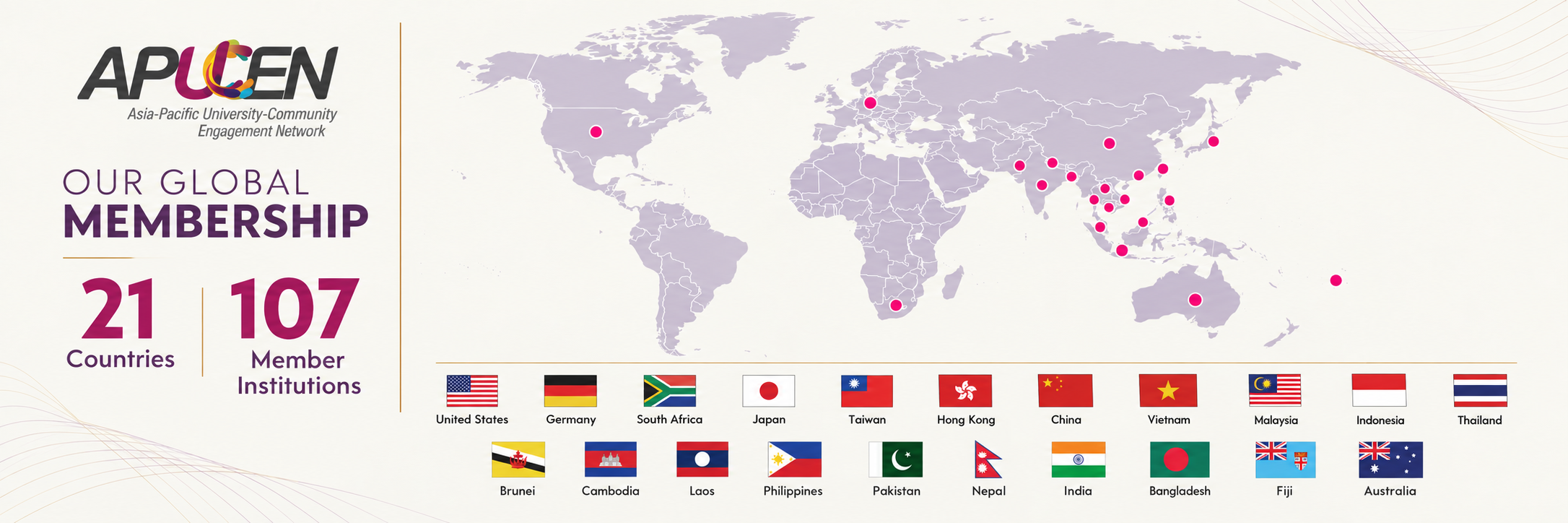
                                               APUCEN MEMBER    
NO. INSTITUTIONAL/AFFILIATE/ASSOCIATE/CORPORATE  COUNTRY/REGION MEMBER SINCE
1 Royal University of Law and Economics Cambodia 2010
2 University of Brawijaya Indonesia 2010
3 Thammasat University Thailand 2010
4 Suratthani Rajabhat University Thailand 2010
5 Walailak University Thailand 2010
6 Mae Fah Luang University Thailand 2010
7 Chiang Mai University Thailand 2010
8 Mahidol University Thailand 2010
9 Universiti Putra Malaysia Malaysia 2010
10 Universiti Malaysia Pahang Malaysia 2010
11 Universiti Sultan Zainal Abidin Malaysia 2010
12 Universiti Malaysia Kelantan Malaysia 2010
13 Universiti Pendidikan Sultan Idris Malaysia 2010
14 Universiti Malaysia Terengganu Malaysia 2010
15 Universiti Teknologi Malaysia Malaysia 2010
16 Universiti Malaysia Perlis Malaysia 2010
17 Universiti Utara Malaysia Malaysia 2010
18 Universiti Sains Islam Malaysia Malaysia 2010
19 Universiti Tun Hussein Onn Malaysia Malaysia 2010
20 Universiti Malaysia Sabah Malaysia 2010
21 Universiti Malaysia Sarawak Malaysia 2010
22 Universiti Teknologi Mara Malaysia 2010
23 Universiti Teknikal Malaysia Melaka Malaysia 2010
24 Universiti Tenaga Nasional Malaysia 2010
25 Universiti Sains Malaysia Malaysia 2010
26 Universiti Kebangsaan Malaysia Malaysia 2010
27 Australian College of Applied Psychology Australia 2011
28 The University of Queensland Australia 2011
29 Hong Kong Institute of Education China (Hong Kong) 2011
30 The Hong Kong University of Science and Technology China (Hong Kong) 2011
31 Universitas Pendidikan Indonesia Indonesia 2011
32 State University of Malang Indonesia 2011
33 Lambung Mangkurat University Indonesia 2011
34 Universitas Negeri Medan Indonesia 2011
35 Universitas Negeri Surabaya Indonesia 2011
36 Universitas Islam Negeri Sultan Syarif Kasim Riau Indonesia 2011
37 Universitas Islam Negeri Riau Indonesia 2011
38 Ateneo De Manila University Philippines  2011
39 San Pedro College Philippines  2011
40 Abdus Salam School of Mathematical Sciences Lahore Pakistan 2011
41 University of The Punjab Pakistan 2011
42 National University of Sciences and Technology Pakistan 2011
43 St. Ann’s College of Education (Autonomous) Mangalore South India India 2011
44 Salesian College Sonada/Siliguri, Bengal India India 2011
45 The University of The South Pacific Fiji 2011
46 Universiti Pertahanan Nasional Malaysia Malaysia 2011
47 Deakin University Australia 2012
48 University of Southern Queensland Australia 2012
49 Kolej Universiti Perguruan Ugama Seri Begawan Brunei 2012
50 Universitas Andalas Indonesia 2012
51 Kyoto University of Foreign Studies Japan 2012
52 Universiti Islam Antarabangsa Malaysia Malaysia 2012
53 Griffith University Australia 2013
54 University of Battambang Cambodia 2013
55 Ming Dao University China (Taiwan) 2013
56 Chulalongkorn University Thailand 2013
57 Universiti Tunku Abdul Rahman Malaysia 2013
58 The University of Nottingham, Malaysia Campus Malaysia 2013
59 AIMST University Malaysia 2013
60 Asia E-University Malaysia 2013
61 Albukhary International University Malaysia 2013
62 Universitas Trilogi Indonesia 2013
63 Toyohashi University of Technology Japan 2014
64 Kadambari Memorial College of Science And Management Nepal 2014
65 KDU College Penang Campus Malaysia 2014
66 I-Shou University China (Taiwan) 2014
67 J.F. Oberlin University Japan 2014
68 Daffodil International University Bangladesh 2014
69 Universitas Surabaya Indonesia 2015
70 Universiti Islam Sultan Sharif Ali Brunei 2015
71 Universiti Malaya Malaysia 2015
72 Universitas Malikussaleh Indonesia 2015
73 Bangladesh Agricultural University Bangladesh 2015
74 Naresuan University Thailand 2015
75 Prince of Songkhla University Thailand 2015
76 International Medical University Malaysia 2015
77 Taylor’s University-Lakeside Campus Malaysia 2015
78 Rhodes University South Africa 2015
79 Universitas Islam Negeri Alauddin Makasar Indonesia 2015
80 Kuala Syiah University Indonesia 2017
81 DRB Hicom University of Automotive Malaysia Malaysia 2017
82 Universiti Teknologi Petronas Malaysia 2017
83 UIN Ampel Surabaya Indonesia 2017
84 Politeknik Seberang Perai Malaysia 2017
85 Kiel University Germany 2018
86 Ho Chi Minh City University of Economics and Finance Vietnam 2018
87 Far Eastern University Philippines 2019
88 Tokai University Educational Japan 2020
89 Chongqing Perham Education China 2021
90 International Techzone China (Hong Kong) 2023
91 Penang Rose Charities Association Malaysia 2024
92 Chinese People’s Federation For World Peace Malaysia Malaysia 2024
93 Living Knowledge-International Science Shop Network Germany 2012
94 DVV-International Laos 2014
95 Global Knowledge Initiative United State of Africa 2014
96 Collegiate Association for The Research of Principles of Penang Malaysia 2017
97 Rajanagarindra Institute of Child Development Thailand 2012
98 Yayasan Sukarelawan Siswa Malaysia 2013
99 Engage Nepal 2014
100 MMICare Association Malaysia 2015
101 Saar Nepal Nepal 2016
102 MyPerintis (Malaysia Trailblazers Association) Malaysia 2019
103 Chongqing Westlife Group Cultural Communication Co. Ltd China 2020
104 Toray Industries (Malaysia) Sdn. Bhd Malaysia 2015
105 Mywave Sdn. Bhd Malaysia 2016
106 Starlab Bioscience Sdn. Bhd Malaysia 2017
107 Philippines Women's College Philippines 2025


Objectives of APUCEN

The objectives of the regional network are as follows:-

  • To promote and instill the community-engagement concept and values to staff and students of institutions of higher learning.
  • To create capacity building for university-community partnerships.
  • To disseminate and share information, knowledge, resources and good practices.
  • To provide a platform for joint flagship projects.
Council Member
LIST OF COUNCIL MEMBER 2025-2027
UNIVERSITY COUNTRY
Universiti Sains Malaysia (PRESIDENT) Malaysia
Universiti Putra Malaysia (VICE PRESIDENT) Malaysia
Universiti Sains Islam Malaysia Malaysia
Universiti Utara Malaysia Malaysia
International Medical University Malaysia
Universiti Tunku Abdul Rahman Malaysia
Kolej Universiti Perguruan Ugama Seri Begawan Brunei
Universitas Surabaya Indonesia
San Pedro Collage Philippines 
Chulalongkorn University Thailand
Thammasat University Thailand
Chongqing Perham Education Cultural Communication China
Penang ROSE Charities Malaysia


Contact Us

Executive Director: Prof. Dato' Dr. Aileen Tan Shau-Hwai

APUCEN Secretariat:
Asia Pacific University-Community Engagement Network (APUCEN)
Division of Industry and Community Network
Level 1, Building E42, Chancellory II,
Universiti Sains Malaysia,
11800 USM,
Pulau Pinang, Malaysia

Tel:  +604 653 6419
Fax: +604 653 6407
E-mail: